
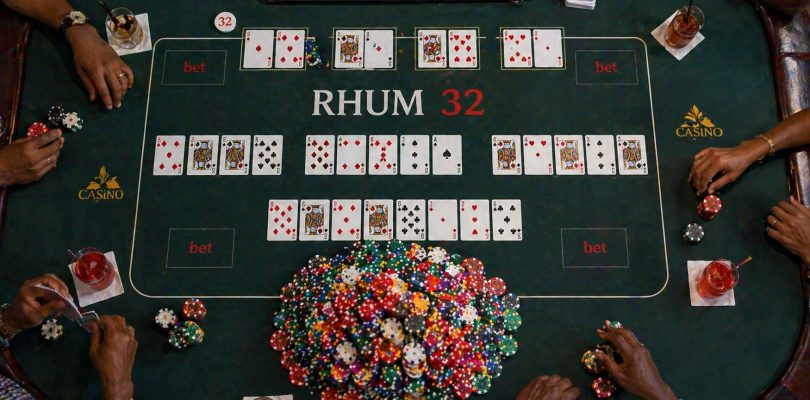
The Edge Game: Advanced Strategy, Psychology and Probability in Rhum 32
What Separates the Consistent Winners from Everyone Else at the Table
Most people who play Rhum 32 understand the rules within a few hands. A smaller number understand the strategy. And a smaller number still have developed the kind of deep, intuitive feel for the game that makes them genuinely dangerous to sit across from — players who lose gracefully and win consistently, who read the table the way a musician reads a room, and who have turned what looks like a luck-driven casino game into something closer to a craft.
This article is for that third group, or for anyone who wants to join it.
- Reframe the Game Entirely
Most beginners think of Rhum 32 as a guessing game — will the fifth card help me or hurt me? Advanced players know this framing is wrong. Rhum 32 is an information management game with a probability engine running underneath it.
At every point in the hand you hold information: your four cards, the dealer’s face-up card, what other players at the table are showing, what has been surrendered, and — if you are paying close attention across hands — a developing sense of deck composition. The question is never will I get lucky? The question is always given what I know, what is the highest-value decision available to me right now?
That shift in framing changes everything. It turns a passive experience into an active one. And it is the foundation on which every other piece of strategy in this article rests.
- The Mathematics of the Play/Surrender Decision
The decision to play or surrender is the most consequential moment in every hand of Rhum 32. Most players make it on instinct or vague gut feeling. Advanced players make it with a clear mathematical framework in mind.
The core equation: When you play, you are risking your ante (to lose) in exchange for the possibility of winning both your ante and bet according to the pay table. When you surrender, you lose your ante with certainty. The break-even point is therefore when your expected return from playing is equal to the certain loss of surrendering.
The decision threshold: In practical terms, this means you should always play when your four-card total is low enough that a reasonable range of fifth cards keeps you in a profitable payout bracket — and always surrender when even the best possible fifth card cannot bring your expected return above the cost of playing.
A working model for the play/surrender boundary:
- Total of 0–15 points with no spread: The vast majority of fifth card outcomes leave you in a competitive position. Play.
- Total of 16–20 points with no spread: Your position depends heavily on the dealer’s visible card. Against a high dealer card (10-value), this is a borderline play. Against a low dealer card (Ace through 4), lean toward surrender.
- Total of 21–25 points with no spread: You need either a very high dealer total or a very favourable fifth card to win. The math generally favours surrender unless the dealer is showing a 10-value card.
- Total above 25 with no spread: Surrender is almost always correct. You are paying to chase a long-shot fifth card while the dealer needs to bust above 32 for you to see any return at all.
- Any hand with a spread present: Recalculate your total after applying the spread before making any decision. A hand that looks like 28 points may actually be 8 after a three-of-a-kind spread wipes 20 points off the board. Never assess a hand before fully accounting for spread potential.
The spread threshold exception: If your hand contains an incomplete but achievable spread — say two cards of a matching rank and a third card of the same rank sitting one position away from completing a three-of-a-kind — your play decision must factor in the probability of completion on the fifth card. With three unseen cards of that rank remaining in the deck, the odds are real. With one remaining, they are slim. Know the difference.
- Spread Probability — Thinking in Likelihoods, Not Just Hopes
The spread is the most powerful mechanic in Rhum 32 and the one most players under-analyse. Advanced players do not just hope for spreads — they evaluate the probability of completing a partial spread before deciding whether to play.
The basic framework:
A standard deck has 52 cards. After four cards are dealt to you and one dealer card is visible, you have seen five cards. That leaves 47 unseen cards.
Completing a three-of-a-kind: You hold two Sevens. There are four Sevens in the deck. You have seen two. Two remain in the 47 unseen cards. The probability of drawing a Seven on the fifth card is 2/47 — approximately 4.3%. This is a long shot. Do not make a marginal play primarily on the basis of completing this spread.
Completing a running flush: You hold the 6 and 7 of Diamonds. You need either the 5 of Diamonds or the 8 of Diamonds. Each of those cards has a probability of 1/47 if unseen — but there are two of them (the 5 and the 8), giving you a combined 2/47 chance of approximately 4.3% unless one of those cards has already appeared. Again, a long shot as a sole basis for playing.
The partial spread that is already doing work: If you hold the 5, 6, and 7 of Spades already in your four-card hand, that three-card running flush is already a spread — counting as zero. The question is not whether you complete it but whether the fifth card improves your remaining total. In this scenario you have zero points from the spread and only your fourth card contributing to your total. Your decision to play should be based on that remaining card’s value, not on spread hopes.
Four-card spreads: The most powerful pre-decision position is holding four cards that form a complete spread — three-of-a-kind plus a fourth card, or four cards in running flush sequence. Your total before the fifth card is just your non-spread card (or zero if all four form the spread). Fifth card variability is almost always manageable from this position. Play essentially every time.
The practical implication: Do not conflate wanting a spread with having sufficient probability of a spread. Many players stay in on high totals hoping to complete a spread they are unlikely to hit. Advanced players only weight spread completion probability in their decision when the base-case hand (without the spread) also justifies playing.
- Reading the Dealer’s Face-Up Card
The single piece of information the dealer gives you before your decision is the face-up card — and it is more informative than most players treat it.
What it tells you directly: One of the dealer’s four cards and its value. If the dealer is showing a King (10 points), you know at minimum 10 of their total is accounted for. If they are showing an Ace, you know only 1 point is visible.
What it tells you probabilistically: The dealer’s remaining three hidden cards are random, but their expected distribution follows the deck’s composition. With 13 ranks in the deck and face cards (J, Q, K) each worth 10, the average card value in a standard deck is approximately 6.5 points. So the expected value of three unseen cards is roughly 19.5 points.
This means:
- Dealer shows a 10-value card: Expected dealer total before the fifth card is roughly 10 + 19.5 = 29.5. The dealer is likely to end up in the 25–35 range. There is meaningful bust probability here.
- Dealer shows a low card (Ace through 4): Expected dealer total before the fifth card is roughly 1–4 + 19.5 = 20.5–23.5. The dealer will almost certainly qualify and likely have a moderate-to-low total.
- Dealer shows a mid card (5 through 9): Expected dealer total is 24.5–28.5. The dealer will usually qualify, with varying room left for their total to be beaten.
The strategic implication:
Against a high dealer face-up card (10-value), you should play slightly more aggressively than normal, because dealer bust probability is elevated. A dealer total above 32 means your ante wins regardless of your hand. When there is meaningful dealer bust probability in play, the value of staying in increases even on a marginal hand.
Against a low dealer face-up card, you need to be genuinely competitive in hand value to justify playing. The dealer will almost certainly qualify with a decent total. You need to beat them on merit.
- Multi-Player Dynamics and Table Position
Rhum 32 is a community game — a fact with real strategic implications that advanced players understand and exploit.
Card sequence and the community deck: The cards dealt to every player at the table come from the same sequential shoe. When a player surrenders and does not receive a fifth card, the remaining cards are redistributed — the card that would have gone to that player now goes to the next player or the dealer. This is not just an interesting observation. It is a strategic lever.
Counting visible information: Every card dealt face-up to any player at the table is information. In Rhum 32, the dealer’s fourth card is face up, and when players reveal their hands at the end, those cards are no longer in the deck for the next shoe. Advanced players who maintain a loose running count of card distributions across hands gain a probability edge — even a rough sense of whether the remaining deck is rich in high-value or low-value cards influences both the play/surrender decision and the insurance decision.
The fold-and-flow effect: When players in early table positions fold, the dealer’s subsequent cards change. There is no perfect way to model this without complete information, but advanced players develop a qualitative sense of table dynamics. A table where several players surrender early will result in the dealer receiving different cards than a table where everyone plays. This is why experienced players pay close attention to what hands other players are showing, even when it does not directly affect their own position.
Playing last at the table: Being the last player to act before the dealer is a subtle positional advantage in Rhum 32. You have seen the most visible information — every player ahead of you has already made their decision and, to the extent any cards are shown, you have the fullest picture. When in doubt between playing and surrendering, this positional information is worth accounting for.
Etiquette and its strategic dimension: The frustration experienced players express when a player surrenders at the wrong time is not merely social. If a player in the third seat folds on a total of 15 points with the dealer showing a King — a clear play — and the dealer consequently draws a Two instead of what would have been a higher card, the table’s collective outcome changes. Advanced players understand this dynamic and use table etiquette as a subtle form of influence — not through pressure, but through calm, demonstrably correct play that signals experience and earns the quiet deference of less certain players.
- The Insurance Bet — A Serious Strategic Tool, Not a Side Amusement
Many advanced players dismiss the insurance bet because it sits outside the main game logic. This is a mistake. For the right player with the right approach, insurance is a serious part of the Rhum 32 financial model.
The expected value framework for insurance:
The insurance bet pays according to your final hand total — independent of whether you beat the dealer. Its value is therefore purely a function of how frequently you achieve each pay bracket, multiplied by each bracket’s payout.
A zero-point hand (complete spread across all five cards) pays $5,000 on a $5 insurance bet. This is a 1,000 to 1 return. The probability of a complete five-card spread is extremely low — but it is not zero, and in extended sessions across many hands, the question becomes whether the cumulative cost of insurance outweighs the infrequent but massive payouts.
The mathematically sophisticated approach is to calculate your personal historical frequency of landing in each pay bracket and compare the implied return against the cost. Most players will find that moderate-range hands (4–11 points) occur frequently enough that the $250 and $125 payouts from insurance generate meaningful cumulative return against a $5 cost.
The case for consistent insurance:
Insurance in Rhum 32 is not truly analogous to insurance in Blackjack, where it is a side bet against a specific dealer outcome. In Rhum 32, insurance pays on your hand performance regardless of the dealer. This means it functions more like a parallel bet on your own card quality — and your card quality is something you have some influence over through the play/surrender decision.
A player who plays optimally — surrendering bad hands, playing strong ones — will, over time, land in favourable pay brackets more often than a player playing randomly. Insurance rewards precisely this discipline. The player who consistently makes correct play decisions and consistently holds insurance is extracting value from both streams simultaneously.
The Ace-through-5 suited hand: This is the crown jewel of the insurance structure — a $10,000 payout on a $10 bet for five cards in running flush sequence starting with the Ace. Advanced players know this hand exists and track suited sequences across the four cards they hold before the fifth is dealt. A hand holding the Ace, 2, 3, and 4 of the same suit is one card from this payout. If you ever hold this position and have not placed insurance, you have made an error.
- Bankroll Management and Session Strategy
Rhum 32 has structural features that make proper bankroll management particularly important for advanced players.
The ante-plus-bet structure doubles exposure on every played hand. Unlike a flat-bet game, each hand you choose to play costs you twice your ante. Across a session of 100 hands where you play 70% of them, you have committed 170 ante units — 100 before decisions and 70 more in play bets. Plan your session bankroll around this reality, not just the flat ante cost.
The payout distribution is highly skewed. The majority of winning hands pay even money or 2 to 1. Occasional hands pay 3 to 1 or 4 to 1. Rare hands pay 20 to 1 or 50 to 1. This means that Rhum 32 results, even for a skilled player, are characterised by long periods of modest gains and losses punctuated by occasional significant wins.
This distribution demands a specific session strategy: protect your stack in the ordinary hands, play aggressively when premium opportunities present themselves. In practical terms, this means sticking to table-minimum bets on average hands and scaling up only when your four-card position is genuinely strong — sub-10 total with spread potential, or a hand where you already have a confirmed spread in place.
The stop-loss discipline: Because variance in Rhum 32 is meaningful — a run of high-total hands followed by unfavourable fifth cards can deplete a session bankroll quickly — advanced players set hard stop-loss limits and respect them. Chasing losses in a skewed-distribution game like this amplifies the worst part of the variance while cutting short the recovery time. Walk when the session is over, even if the table is warm.
- Psychological Mastery at the Table
The psychological dimension of Rhum 32 is underappreciated because the game does not have the explicit adversarial dynamic of Poker or the pure speed of Blackjack. But the table is a social environment, and social environments carry psychological pressures that influence decisions.
The pressure to play when you should surrender: At a busy, loud table where other players are playing aggressively and winning, the social atmosphere creates implicit pressure to stay in. A player who folds repeatedly feels the eyes of the table. Advanced players are completely indifferent to this pressure. The correct decision is the correct decision. A surrender on a 23-point hand is correct regardless of how many other people at the table are playing 19-point hands and getting lucky.
The pressure to surrender when you should play: The opposite pressure is subtler but equally real. At a table where a run of bad fifth cards has hurt several players in a row, the mood can turn cautious. Players start folding earlier than the math justifies, trying to protect antes from a fifth card they have convinced themselves will be bad. This is the gambler’s fallacy in action — the deck has no memory. A sequence of unfavourable fifth cards has no bearing whatsoever on the probability of the next one.
The emotional volatility of the spread: The spread is the most emotionally charged moment in Rhum 32. When you hold a partial spread and miss the fifth card, the drop from 50-to-1 fantasy to an over-17 payout is a genuine psychological blow. Advanced players neutralise this by pre-accepting both outcomes before the card is dealt. You hold a partial spread and the probability is what it is. The outcome was always going to be one of two things. Neither outcome should change your emotional state or your next decision.
Reading other players’ reactions: While you cannot see other players’ hole cards, their reactions to the fifth card and the final reveal carry information. A player who flinches when their fifth card is dealt likely received something bad. A player who relaxes visibly likely hit a spread or a low total. This information is at the margins of usefulness, but at a table where you are trying to assess table-wide card distribution, it is worth noting.
- The Specific Hands Every Advanced Player Knows Cold
Certain hand configurations in Rhum 32 require zero deliberation — the correct action is automatic for a serious player.
Automatic plays (never surrender):
- Any hand with a confirmed three-of-a-kind or running flush spread already in place
- Any four-card total of 10 or less
- Any hand where a four-of-a-kind is present
- Any four-card running flush in the same suit (complete spread, zero points before fifth card)
Automatic surrenders (never play):
- Any four-card total above 27 with no spread and no realistic spread completion
- Any total above 22 against a dealer showing a low card (Ace through 4) with no spread
- A total of 25 or more with no suit or rank pattern in the hand at all
The genuinely difficult decisions (where advanced thinking separates players):
- Total of 17–21, dealer showing a 10-value card, no spread but two cards of the same rank
- Total of 15–18, dealer showing a 2 or 3, two-thirds of a running flush visible
- Total exactly at the 17-point pay bracket boundary — playing wins you 2 to 1; a bad fifth card drops you to 1 to 1 but costs you the same bet
The last category — hands near pay bracket boundaries — is where the best players spend the most cognitive time. The difference between finishing at 17 points (2 to 1) and 18 points (1 to 1) is a full pay bracket on your bet. This makes it worth thinking carefully about the fifth-card distribution that could push you across the line in either direction.
- The Compound Principles
After all the probability, position awareness, insurance analysis, and psychology, the foundation of advanced Rhum 32 comes down to a set of compound principles that advanced players apply simultaneously, in real time, every hand.
Never make a decision before completing spread analysis. A hand assessed without accounting for spreads is not assessed at all.
The dealer’s face-up card is a prior probability, not a certainty. Use it to calibrate, not to guarantee.
Play to the pay bracket, not just to win. There is a meaningful difference between a winning hand that pays 1 to 1 and a winning hand that pays 4 to 1. When your hand sits near a bracket boundary, the fifth card is fighting for bracket position as much as for outright win probability.
Insurance is a parallel game. Manage it as such — with its own logic, its own stake allocation, and its own separate discipline.
The table is part of your information environment. Other players’ cards, decisions, and reactions all carry signal. Absorb it.
Emotional neutrality is a competitive advantage. A player who is unaffected by a missed spread, an unlucky fifth card, or a dealer bust that wipes out a hand they surrendered is a player who will make correct decisions on the next hand. The game rewards equanimity as directly as it rewards mathematical knowledge.
Variance is not your enemy — it is your context. Rhum 32 has meaningful short-term variance. Accept it. Play correctly across hundreds of hands and the correct decisions will express themselves in results. Deviate from correct play because of short-term results and you hand the house an edge it did not earn.
Rhum 32 rewards the patient, the analytical, and the emotionally disciplined. The players who have been at the same table for twenty years are not there because they are lucky. They are there because they understand the game at a level that makes luck largely irrelevant in the long run. That understanding is available to anyone willing to develop it.
Always gamble responsibly and within your means.